Abstract
Research on characteristics, composition, size, shape (fragment, fiber, granular), distribution, and content of microplastics in coastal sediments was conducted through boreholes and excavations on identified cross-sections. Field surveys were conducted in the rainy and dry seasons, drilling (2m/borehole) and excavations (1.0 x 0.8 x 1.0) to collect samples at low tide. Changes in sediment environment and microplastics in the 2m borehole column, and seasonal changes in sediment structure and microplastics were studied in the excavations. Changes in microplastic content in the sediment sample column (borehole, excavation) and sediment OSL age were also determined. Synthesizing documents on the cross-sections will determine the distribution characteristics of microplastics in coastal alluvial sediments in the study area. Coastal sedimentary environments are determined based on analysis of grain size, sediment structure and diatoms in borehole and excavation samples. In addition, geomorphology and coastal sediments play an important role in determining sedimentary environments such as intertidal, subtidal, beach, sand bar, etc. The presence of microplastics with varying composition and content in borehole sedimentary environments of geological cross-sections is the basis for studying the distribution and source of microplastics. The research results show that the microplastic content is medium to very low, about 0-300 microplastics / 1000 g of dry sediment sample, often found in fine, medium and silty sand in the upper intertidal sediments (0 to -0.6 m) with an age of about 30 years ago (OSL age), and does not appear in the lower part of the drill core (from -0.7 m to -2 m). In addition, microplastics do not appear in clay-silt and clay-silt-sand. Two areas with quite concentrated microplastic content are the intertidal flats of Soai Rap and Dong Tranh rivers in Dong Hai commune and the Long Tau river mouth area in Can Thanh town; the intertidal flats in the middle of Long Hoa commune has a non-concentrated microplastic content.
Keywords
Microplastics, Coastal Sediments, Beach, Can Gio HCMC, Boreholes, Intertidal
1. Introduction
Microplastics are very small plastic particles, ranging in size from 1 µm to 5 mm, in the form of fibers, fragments, and beads
| [1] | Arthur, C., Baker, J., Bamford, H., 2009. Proceedings of the International Research Workshop on the Occurrence, Effects and Fate of Microplastic Marine Debris, p. 49 (NOAA Technical Memorandum NOS- OR&R-30). |
| [2] | Andrady AL, 2011. Microplastics in the marine environment. Marine Pollution Bulletin 62: 1596–1605.
https://doi.org/10.1016/j.marpolbul.2011.05.030 |
[1, 2]
. Depending on their origin, microplastics are divided into primary and secondary microplastics. Primary microplastics are plastic particles that are produced and used directly as raw materials in the production of plastics, cosmetic products, detergents, etc. Secondary microplastics are small plastic fragments originating from the decomposition of plastic debris. Microplastics (primary and secondary) are found in water, sediments, and animals living in river, coastal, and ocean environments originating from land-based flows
| [3] | Jake Martin, Amy Lusher, Richard C. Thompson 2 & Audrey Morley, 2017. The Deposition and Accumulation of Microplastics in Marine Sediments and Bottom Water from the Irish Continental Shelf. Scientific reports 7: 10772, p. 1-9,
https://doi.org/10.1038/s41598-017-11079-2 |
| [4] | Catherine L. Waller, Huw J. Griffiths, Claire M. Waluda, Sally E. Thorpe, Iván Loaiza, Bernabé Moreno, Cesar O. Pacherres, Kevin A. Hughes, 2017. Microplastics in the Antarctic marine system: An emerging area of research. Elsevier, Science of the Total Environment 598: 220-227.
https://doi.org/10.1016/j.scitotenv.2017.03.283 |
[3, 4]
. Research on the spatial distribution (concentration, mass, type, and/or size) of microplastic pollutants has focused on three components of the marine environment: sediments, water columns, and surface water. In these studies, in addition to determining the morphological size, quantity distribution, and concentration ratio of microplastic pollutants, the studies also focused on determining the source of microplastic pollutants in the marine environment
| [5] | Dris, R., Gasperi, J., Saad, M., Mirande, C., Tassin, B., 2016. Synthetic fibers in atmospheric fallout: a source of microplastics in the environment? Marine pollution bulletin, 104(1-2), 290-293.
https://doi.org/10.1016/j.marpolbul.2016.01.00 |
[5]
.
The abundance and spatial distribution of microplastics are affected by environmental factors including currents, waves, tides, cyclones, and wind direction
| [6] | Fauziah Shahul Hamid, Mehran Sanam Bhatti, Norkhairiyah Anuar, Norkhairah Anuar, Priya Mohan and Agamuthu Periathamby, 2018. Worldwide distribution and abundance of microplastic: How dire is the situation? Waste Management & Research, vol. 36(10) 873-897.
https://doi.org/10.1177/0734242X18785730 |
[6]
. A study on the influence of sedimentary environments on the abundance of microplastics was conducted on the Bristol Channel beach in the UK, and the results showed that microplastics were highly concentrated in low-energy beaches corresponding to fine-grained sediments
| [7] | Wilson D. R. et al., 2021. The influence of depositional environment on the abundance of microplastic pollution on beaches in the Bristol Channel, UK. Marine Pollution Bulletin 164 (2021) 111997. https://doi.org/10.1016/j.marpolbul.2021.111997 |
[7]
. Estuaries are the main transport routes for plastics originating from the mainland to the ocean, but are relatively low compared to coastal and open ocean environments. The distribution and transport of microplastics in salt marshes showed a good relationship with tidal regimes and a weak relationship with suspended sediment concentrations
| [8] | Stead J. L. et al., 2020, Identification of tidal trapping of microplastics in a temperate salt marsh system using sea surface microlayer sampling. Scientific Report 10: 14147.
https://doi.org/10.1038/s41598-020-70306-5 |
[8]
. Microplastics are often found in high concentrations in estuaries, nearshore waters, and in sediments where human populations are concentrated. Microplastics are mainly in the form of particles and fibers, present at depths of 0-50 cm in coastal tidal sediments with densities of 200-1,900 particles/kg of dry sediment in Singapore, Japan, Hong Kong, and China
| [9] | Kathryn A. Willis, Ruth Eriksen, Chris Wilcox and Britta D. Hardesty, 2017. Microplastic Distribution at Different Sediment Depths in an Urban Estuary. Article in Frontiers in Marine Science. https://doi.org/10.3389/fmars.2017.00419 |
[9]
. In addition, microplastics accumulated in bivalves are the most studied among marine animals due to their filter-feeding mode of nutrition
.
Recent studies have shown that microplastic pollution is a hot environmental issue in countries around the world and is of interest to research, especially in the marine environment, which will be a source of water, sediment, and marine life pollution. After China, Indonesia and the Philippines, Vietnam is one of the countries with the largest amount of plastic waste discharged into the environment in the world. However, to date, research on microplastic pollution in water bodies and the risks of impact on the environment and marine life is still quite limited.
Due to the structural characteristics of synthetic polymers, plastic waste has a very slow decomposition rate and can persist in the environment for hundreds of years, leading to many serious environmental problems related to plastic waste. Vietnam is the third highest plastic consumer in Southeast Asia (after Malaysia and Thailand) with an average plastic consumption per capita of 41 kg/year in 2015 (10 times higher than in 1990)
| [11] | Lahens, L. et al., 2018. Macroplastic and microplastic contamination assessment of a tropical river (Saigon River, Vietnam) transversed by a developing megacity. Environmental Pollution 236, 661-671.
https://doi.org/10.1016/j.envpol.2018.02.005 |
[11]
. With more than 1.8 million tons of plastic waste per year and only 27
% recycled, plastic pollution has become a major problem threatening the coastal environment of the country. Vietnam is identified as the country with the 4th largest amount of plastic waste in the world with an estimated 0.28–0.73 million tons of plastic discharged into the marine environment each year
| [12] | Nguyen, N. T., et al., Distribution of microplastics in surface water from Saigon River to Can Gio Sea. Science Technology Development Journal: Science of the Earth Environment 2023. 7(2): p. 753-763. https://doi.org/10.32508/stdjsee.v7i2.735 |
| [13] | Jambeck, J. R., Geyer, R., Wilcox, C., Siegler, T. R., Perryman, M., Andrady, A., Narayan, R., Law, K. L., 2015. Plastic waste inputs from land into the ocean. Science 347, 768e771.
https://doi.org/10.1126/science.1260352 |
[12, 13]
. A survey conducted by IUCN and Greenhub (IUCN, 2019) showed that plastic waste accounted for 92% of the total debris collected on Vietnam's beaches
| [14] | Truong Huu Duc và et al., 2020. Characteristics of composition and distribution of microplastic particles in surface sediment environment of Tien Yen Bay area. Journal of Hydrometeorology, 719, 14-25.
https://doi.org/10.36335/VNJHM.2020(719).14-25 |
[14]
. However, to date, information on the distribution of microplastics in estuaries and coastal areas is very limited, which can make it difficult to assess the current status of plastic pollution as well as to have an effective management strategy. Microplastics were found in Da Nang city beach sediments, in which synthetic fibers dominated at about 99.2% with a content of about 9,238-2,097 items/kg dry weight. Microplastics tend to be concentrated in beach surface sediments, in which about 81.9% of synthetic fibers with a size of 300-2600 μm are a threat to the ecosystem and human health
| [15] | Quynh Anh Tran Nguyen et al., 2020. Characteristics of microplastics in shoreline sediments from a tropical and urbanized beach (Da Nang, Vietnam). Marine Pollution Bulletin 161, 111768. https://doi.org/10.1016/j.marpolbul.2020.111768 |
[15]
. Research on microplastics in tidal sediments in Hau Loc district, Thanh Hoa province showed that microplastics were about 0.25-5 mm in size, with a content of about 2,921-5,635 microplastic particles/kg of dry sediment, indicating that the tidal flats here are affected by microplastic pollution
| [16] | Luu Viet Dung, et al. 2020. Research on methods for determining microplastics in coastal tidal sediments, experimental application in Da Loc commune, Hau Loc district, Thanh Hoa province. Journal of Meteorology and Hydrology, 715, 1-12. https://doi.org/10.36335/VNJHM.2020(715).1-12 |
[16]
.
Some studies on microplastics were conducted on bivalve samples in the natural environment, the results showed diversity in the level of pollution as well as the characteristics of microplastics such as size, color, shape and nature of microplastics. The microplastic content in Green-shelled mussels (Perna Viridis) was about 2.60 microplastic fibers/individual and about 0.29 microplastic fibers/gramme of fresh meat up to dozens or even hundreds of microplastic particles in 1 gram of fresh meat or a bivalve individual
. The presence of microplastics in seafood poses a risk to human food safety, not only to local communities but also to tourists and residents in seafood importing countries.
In Ho Chi Minh City, there are about 1,600 tons of plastic waste every day, a large amount of which floats on ponds, lakes, canals, rivers... and flows into the ocean. According to the Department of Natural Resources and Environment, each year Ho Chi Minh City discharges about 250,000 tons of plastic waste, of which about 48,000 tons are sent to landfills and the remaining 200,000 tons are sent to the river system, canals and sewers. In addition, analysis and assessment of plastic and microplastic pollution in the Saigon River and 04 main canals in the central area of the city was conducted. The results of microplastic analysis in river and canal water showed that microplastic fibers and fragments predominate with high concentrations of about 172,000-519,000 fibers/m
3 and 10-223 fragments/m
3 of water
| [11] | Lahens, L. et al., 2018. Macroplastic and microplastic contamination assessment of a tropical river (Saigon River, Vietnam) transversed by a developing megacity. Environmental Pollution 236, 661-671.
https://doi.org/10.1016/j.envpol.2018.02.005 |
| [12] | Nguyen, N. T., et al., Distribution of microplastics in surface water from Saigon River to Can Gio Sea. Science Technology Development Journal: Science of the Earth Environment 2023. 7(2): p. 753-763. https://doi.org/10.32508/stdjsee.v7i2.735 |
[11, 12]
. This shows that the risk of microplastic pollution in Saigon River water is very high and the coastal estuary of Can Gio is also the place that receives waste from industrial parks in Dong Nai, Binh Duong, Long An and Ho Chi Minh City. Due to rivers in the Saigon-Dong Nai river system such as Vam Co, Soai Rap, Dong Tranh, Long Tau... and canals, it is transported and accumulated in the sand flats of which, plastic waste from waste sources of industrial parks accounts for a significant portion. Microplastics broken from large pieces of plastic waste are difficult to decompose over time, sediment in alluvial plains pollutes the environment, harms the quality of aquatic products, and will seriously affect aquaculture and human health. In addition, some studies assessing heavy metal pollution (Cu, Pb, Cr, As) in water, sediments and ecological risks of Can Gio coastal estuary have been conducted
| [19] | Sandra Costa-Böddeker et al, 2016. Ecological risk assessment of a coastal zone in Souther Vietnam: Spatial distribution and content of heavy metals in water and surface sediments of the Thi Vai Estuary and Can Gio Mangrove Forest. Marine Pollution Bulletin, 1-11.
https://doi.org/10.1016/j.marpolbul.2016.10.046 |
| [20] | Van Cauwenberghe, L., Janssen, C. R., 2014. Microplastics in bivalves cultured for human consumption. Environmental Pollution, 193, 65–70.
https://doi.org/10.1016/j.envpol.2014.06.010 |
[19, 20]
, in which floating diatom indicators contributed to assessing the water quality of Dong Nai river
| [21] | Pham T. L., 2017. Comparison between Water Quality Index (WQI) and biological indices, based on planktonic diatom for water quality assessment in the Dong Nai River, Vietnam. Pollution, 3(2): 311-323.
https://doi.org/10.7508/pj.2017.02.012 |
[21]
. Microplastics were also found at 04 locations on the beach of Go Cong Dong district Tien Giang province and Vung Tau city. Sample analysis results showed that the microplastic content was about 0-295 microplastic pieces/kg of dry sand sample, of which fragments accounted for about 60.2% in Go Cong Dong and particles accounted for 71.7% in Vung Tau
. In addition, microplastics were also initially detected in tidal sediment samples of Tien, Ham Luong and Co Chien estuaries and Thanh Phu district Ben Tre province that showed about 0-300 microplastic pieces/kg of dry sand sample
| [23] | Ngo Thi Tuong Vy, et. al. Assessment of microplastics pollution level on clam farming and bathing beaches: a case study of Thanh Phu in Ben Tre, Vietnam. International Journal of Environmental Health Research, July 2024 35(4): 1-13.
https://doi.org/10.1080/09603123.2024.2377306 |
| [24] | Gugliotta M., Saito Y., Van Lap Nguyen, Thi Kim Oanh Ta and Tamura T., 2019. Sediment distribution and depositional processes along the fluvial to marine transition zone of the Mekong River delta, Vietnam. Sedimentology, 66, 146-164.
https://doi.org/10.1111/sed.12489 |
| [25] | Jiang Y., Saito Y., Thi Kim Oanh Ta, Wang Z., Gugliotta M., Van Lap Nguyen, 2020. Spatial and seasonal variability in grain size, magnetic susceptibility, and organic elemental geochemistry of channel-bed sediments from the Mekong Delta, Vietnam: Implications for hydro-sedimentary dynamic processes. Marine Geology, 420, 106089.
https://doi.org/10.1016/j.margeo.2019.106089 |
[23-25]
.
In 2018-2019, a study on microplastic pollution in Saigon river water was conducted. In 2018, CARE (Center for Asian Water Research - Ho Chi Minh City University of Technology) studied Saigon River water, the results showed that there were about 10-233 microplastic pieces/m
3 of water and about 172-519 microplastic fibers/liter of water. This shows that the Saigon River is seriously polluted by plastic waste and microplastics. From 2018 to 2020, the Ho Chi Minh City Institute of Resource Geography in collaboration with the Center for Coastal Estuary Research of Shimane University, Japan, studied the relationship between geomorphology, sediments and hydro-oceanography of riverbeds and estuaries of the Saigon-Dong Nai river system. The results distinguished dominant river zones, river-tidal zones, dominant tide zones with geomorphological and sedimentary characteristics of riverbeds, hydro-oceanographic regimes in the rainy and dry seasons, and formation of tidal flats
| [26] | Gugliotta M., Saito Y., Thi Kim Oanh Ta and Van Lap Nguyen, 2019. Valley-Confinement and River-Tidal Controls on Channel Morphology Along the Fluvial to Marine Transition Zone of the Ðồng Nai River System, Vietnam. Frontiers in Earth Science. ISSN 2296-6463; 7: 202, 1-10.
https://doi.org/10.3389/feart.2019.00202 |
| [27] | Gugliotta M., Saito Y., Thi Kim Oanh Ta, Van Lap Nguyen, Uehara K., Tamura T., Nakashima R., Kim Phuong Lieu, 2020. Sediment distribution along the fluvial to marine transition zone of the Dong Nai River System, southern Vietnam. Marine Geology 429, 106314.
https://doi.org/10.1016/j.margeo.2020.106314 |
| [28] | Collins D. S., V. L. Nguyen, T. K. O. Ta, Mao L., Ishii Y., Kitagawa H., Nakashima R., T. H. Q. Vo, Tamura, T., 2021. Sedimentary evolution of a delta-margin mangrove in Can Gio, northeastern Mekong River delta, Vietnam. Marine Geology 433, 106417. https://doi.org/10.1016/j.margeo.2020.106417 |
[26-28]
. In addition, a set of riverbed sediment samples (Soai Rap, Sai Gon, Dong Nai rivers) and coastal alluvial plains of Can Gio district have been collected. Preliminary analysis results show the presence of microplastics in the alluvial plains of Soai Rap river mouth and Dong Tranh bay of Can Gio district. However, these are only initial findings on the presence of microplastics. If there are conditions for further research on the distribution of microplastics in the sediments here, the existing sediment samples will be used as a source of research materials, contributing significantly to the implementation of the topic. Although there are a number of related studies, there is still a lack of information on the accumulation of microplastics in coastal and estuarine sediments. In addition, updating the assessment of the presence and distribution of microplastics in coastal alluvial plains of estuaries is limited due to the lack of standard methods for sample collection and analysis.
From all the above analyses, it is necessary to conduct research to determine the distribution and characteristics of microplastic particles in coastal estuarine sediments. This research will provide the current status of distribution and characteristics of microplastics in coastal estuarine sediments of Can Gio, supplementing important data sources on microplastics to develop environmental protection strategies.
2. Regional Settings
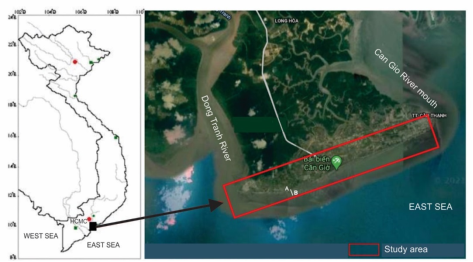
Can Gio District has about 14 km of coastline from Dong Tranh Cape to Can Gio Cape, with large river mouths such as: Long Tau, Cai Mep, Thi Vai, Soai Rap, Dong Tranh (Figure), which are strongly affected by river-sea hydrodynamic interactions. The tidal regime in this sea area is of the irregular semi-diurnal type with a high tide amplitude of ≈ 2m, with two high tides and two low tides per day.
Figure 1. Map of Can Gio area indicating the red rectangle of study area and location of AB cross section.
Up to now, research on microplastic pollution is still very limited, with only a few studies having been conducted and summarized above. In particular, microplastic pollution was detected on the beaches of Go Cong Dong and Vung Tau districts
| [23] | Ngo Thi Tuong Vy, et. al. Assessment of microplastics pollution level on clam farming and bathing beaches: a case study of Thanh Phu in Ben Tre, Vietnam. International Journal of Environmental Health Research, July 2024 35(4): 1-13.
https://doi.org/10.1080/09603123.2024.2377306 |
[23]
adjacent beaches in the southwest and northeast of the coastal estuary of Can Gio district. In addition, microplastics were also initially detected in sediment samples of the tidal flats of the Saigon-Dong Nai estuary
| [26] | Gugliotta M., Saito Y., Thi Kim Oanh Ta and Van Lap Nguyen, 2019. Valley-Confinement and River-Tidal Controls on Channel Morphology Along the Fluvial to Marine Transition Zone of the Ðồng Nai River System, Vietnam. Frontiers in Earth Science. ISSN 2296-6463; 7: 202, 1-10.
https://doi.org/10.3389/feart.2019.00202 |
| [27] | Gugliotta M., Saito Y., Thi Kim Oanh Ta, Van Lap Nguyen, Uehara K., Tamura T., Nakashima R., Kim Phuong Lieu, 2020. Sediment distribution along the fluvial to marine transition zone of the Dong Nai River System, southern Vietnam. Marine Geology 429, 106314.
https://doi.org/10.1016/j.margeo.2020.106314 |
[26, 27]
Tien, Ham Luong and Co Chien rivers
| [24] | Gugliotta M., Saito Y., Van Lap Nguyen, Thi Kim Oanh Ta and Tamura T., 2019. Sediment distribution and depositional processes along the fluvial to marine transition zone of the Mekong River delta, Vietnam. Sedimentology, 66, 146-164.
https://doi.org/10.1111/sed.12489 |
| [25] | Jiang Y., Saito Y., Thi Kim Oanh Ta, Wang Z., Gugliotta M., Van Lap Nguyen, 2020. Spatial and seasonal variability in grain size, magnetic susceptibility, and organic elemental geochemistry of channel-bed sediments from the Mekong Delta, Vietnam: Implications for hydro-sedimentary dynamic processes. Marine Geology, 420, 106089.
https://doi.org/10.1016/j.margeo.2019.106089 |
[24, 25]
. This shows that the risk of microplastic pollution in Saigon river water is very high and Can Gio beach is also at risk of microplastic pollution from industrial zones in Dong Nai, Binh Duong, Long An and Ho Chi Minh City due to the Soai Rap River, Dong Tranh River, Long Tau River, etc. transported to and accumulated in the coastal estuary alluvial plains. With the natural potential of the mangrove forest system in the coastal estuary area, Can Gio has a great advantage in developing tourism and aquaculture.
Characteristics of natural conditions related to coastal sediments
The Can Gio estuary is a small part of the coastal estuary system of the Dong Nai River. This is a low-lying area with a dense system of canals and streams, strongly influenced by the tidal regime of the East Sea. Can Gio district has a basin shape in the central area, with an average elevation of 0.0 - 1.5 m. The coastal area has a high relief due to the foundation being made of ancient sand dunes, the riverside area has a high elevation due to the formation of sediments of river and sea origin. Can Gio has a dense network of rivers and streams, intertwined with large rivers such as Long Tau, Cai Mep. Go Gia, Thi Vai (Northeast) and Soai Rap, Dong Tranh rivers (Southwest); These rivers are all the gateways to the city's waterways with neighboring provinces and are part of the international shipping route connecting Saigon Port with the inland and international. The climate and hydrological characteristics summarized below are related to the assessment of the origin, transport and accumulation of microplastics in the coastal estuary of Can Gio district.
Monsoon regime with 2 main wind directions: Northeast and Southwest:
- Summer monsoon: The prevailing wind is the Southwest monsoon, blowing strongly in May - October, with an average speed of 3 - 5 m/s, affecting from the Southwest to the West - Southwest, the wind blowing from the sea carries a lot of moisture, often accompanied by heavy rain, and increases the flow of fresh water flowing into the sea and causing flooding at the source.
- Winter monsoon: Blows strongly from November to April of the following year, the prevailing wind is the Northeast wind, with an average speed of 1 - 3 m/s. This wind direction combined with the tide increases the ability of the tide to penetrate deep into the fields, and the weather is dry. From December, the prevailing wind is from the North to the Northeast, with an average speed of level 2, and the weather is dry. In January - February, the wind blows from the Northeast to the Southeast, with an average speed of level 3 - 4. In March - April, the main wind direction is from the East to the Southeast, with an average speed of level 3 - 4. The wind speed during the year does not exceed level 7, and there are not many strong winds, level 5 winds often occur in the months of January - April. There are almost no storms, but they are often affected by East Sea storms in the months of November to January of the following year.
Tidal regime
Can Gio is located close to the East Sea coast, so the influence of the Southeast Sea regime is semi-diurnal and has the following characteristics:
- During the day and night, the water level rises and falls twice, forming 2 peaks and 2 troughs of uneven height, in which the peak tide differs by 0.2 - 0.4 m and the trough tide differs by a larger amount of about 1.0 - 2.5 m.
- The daily tidal amplitude is about 2.9 - 3.4 m. In many years, it has reached 4.0 - 4.1 m. A tidal amplitude fluctuates with a period of about 12.4 hours, the day-night cycle is about 24.8 hours.
- In a month, there are 2 tidal cycles, each cycle lasts about half a month. In a half-month cycle, there are 3-5 days of strong tides called high tides, then the tide gradually decreases for 5-6 days, followed by 3-5 days of strong tides at 2 times after the full moon and new moon for 2-3 days.
During the year, the strong tides are from November to January, the highest peak water level reaches 4.1 m, the weakest tides are in June and July, the lowest peak water level is 0.2 m.
Morphologically, the coastal area of Can Gio district is low-lying except for the coastal sand dunes. The terrain has a common elevation of 0.4-1.6 m, divided into sand dunes with an elevation of about 1.8-3.0 m running parallel to the coast in Dong Hoa, Long Hoa communes and Can Thanh town. Mangrove swamps occupy most of the area of Can Gio district. This is a low-lying area with an elevation of about 0.4-0.6 m, with a dense tidal system, flooded at high tide and exposed at low tide. Mangrove swamps are found from behind the tidal flats and/or current coastal sand dunes, spreading to the North. The sediments of the mangrove swamps are mainly composed of clay-silt, about 0.7-1.0 m thick, containing many plant remains and the lower limit is sand, silt-sand or clay-silt sediments of the tidal flats. The main grain size composition includes 80 - 85%, clay - silt, 6 - 14% fine sand and 10 - 22% organic matter. The species of Rhizophora sp., Avicennia sp., and Nippa fruticant are typical of coastal mangrove forests. Tidal flats are newly formed land along the current coast due to the deposition of sediments from river and sea alluvium. In Can Gio district, tidal flats are formed and developed, including coastal tidal flats and newly emerged sandbars or submerged sandbars in coastal estuaries. In terms of morphology and origin, tidal flats include: inter-tidal flats (also known as alluvial flats) and sub-tidal flats (sub-tidal flats or submerged alluvial flats) distributed from the coast to a depth of about -3 or -5 m. The tidal flat is the place that is flooded with sea water when the tide is high and exposed when the tide is at its lowest, extending from the shore to a depth of about -2.5 m to -2.8 m, the submerged alluvial flat is always below sea level at low tide. Depending on the formation characteristics at different locations, the coastal tidal flat of Can Gio district often has a width ranging from 2.5 to 4.5 km and is characterized by sand, sandy clay and clay - silt.
The coastal tidal flat is distributed along the length of Can Gio district from Dong Hoa commune to Can Thanh town, about 15 km long. The tidal flat is a place where topography and geomorphology frequently change. Depending on the distribution location and formation conditions, the grain size composition of the tidal flat can be clay - silt or sand - silt and sand, showing the physical conditions at different locations. In addition, at the same location, the grain size composition is affected by the monsoon regime and can change according to the rainy and dry seasons of the year. Muddy tidal flats often occur in low-energy coastlines sheltered by sand bars or seaward headlands or deep depressions behind sand bars. Muddy tidal flat sediments in the area are composed of silty clay, greenish-gray sandy clay, parallel-layered structure, containing many shells, organic matter and traces of biological activities.
3. Materials and Methods
3.1. Field Survey and Sampling
Field survey, collection of documents, data and drilling to collect sediment samples from tidal flats in the study area. The study to determine the content of microplastics in tidal flat sediments was conducted in sediment samples from drill cores, excavations and tidal flat surface samples. These sediment samples were also taken from sediment samples of 22 shallow boreholes (CG1, 2, 3... 29) and 15 excavations (HD 1, 2... 17) and tidal flat surface samples with appropriate sampling methods and tools and ensuring that microplastics are not contaminated from the outside into the sample as follows:
- Borehole: core samples were taken using a steel tube with a diameter of 69 mm, samples were taken intact along the entire length of 2 m / borehole to study sediment structure and analyze microplastic particles.
- Excavation pits: each pit is 1.0 x 0.8 x 1.0 meters in size, describing sediment characteristics including sediment composition, structure, color, shells, organic matter, etc. and then taking sediment samples contained in a box.
- Samples on the surface of the tidal flat: using a river bottom sediment sampling device (KS-type sediment Sampler manufactured by Rigo Co. Ltd. Japan) made of stainless steel, using a spoon to collect the entire sediment layer of about 10 - 18 cm. Put the sample in a tin box prepared in the laboratory and store it in a sample container. A total of 46 samples were collected. Samples were taken twice in the rainy and sunny seasons to assess seasonal fluctuations. Based on the inheritance of existing documents, within the scope of this topic, the volume of boreholes, excavations and analyzed samples is as follows:
- 22 boreholes (diameter 69 mm; depth 2.0 m);
- 15 excavations (1.0 x 0.8 x 1.0 m);
- 46 tidal surface sediment samples;
The core and excavation samples were cut, sediment characteristics were described, and cross-sections of the boreholes and excavations were established; Samples with clay and silty clay components were cut 2cm/sample; and 4-5 cm/sample with sand and silty-sand components.
3.2. Laboratory Analysis
Particle size analysis: 250 samples;
Microplastic analysis (< 1mm – 2.5 micrometers):
The principle of ensuring cross-contamination was strictly followed with gloves, blouses, and instrument rinsing applied to all microplastic isolation and analysis.
The process of analyzing and evaluating microplastics includes two steps: observing under a stereoscopic microscope and determining the nature of microplastics. The observation and identification of microplastics are performed under a stereoscopic microscope (Olympus SZX2-TR30, magnification: 300 times). A random number of approximately 20% of the observed objects and representative of the sample population will be selected to evaluate the nature of the characteristics.
Microplastic analysis by stereomicroscope:
- Isolation of microplastics: separation, filtration, oxidation, drying: 250 samples;
- Analysis of microplastic composition: 250 samples;
- Analysis of microplastic shape and size under microscope: 250 samples;
- Testing to determine the characteristics of microplastics by scanning electron microscope (SEM-EDX): 50 samples.
Shape, size, color:
- Particles are about 0.09 - 0.95mm in size, commonly: 0.3 - 0.6mm. Beads are black, brown, blue.
- Fragments are 0.2 – 0.97 mm in size, commonly: 0.35 – 0.90 mm. Fragments are black, blue, opaque white, brown.
- Fibers are 0.4 – 0.9 mm in size, commonly: 0.7 – 1.0 mm. Fibers are black, blue, brown.
- Thin films are 0.06 – 1.0 mm in size. Thin films are brown.
4. Results and Discussion
4.1. Sedimentary Environment of Sub- to Intertidal Flat
Based on the sediment characteristics, the results of the analysis of grain size and diatom species, the sedimentary environment of 22 drill cores and 15 excavation pits was determined. The main composition of sedimentary materials is sand, light gray, dark gray sand-clay containing organic matter and shellfish shells, the typical sedimentary structure is parallel and interrupted parallel layering. Some places are characterized by clay, dark gray-green clay-silt containing a lot of organic matter and light gray clay-sand layer. The species of diatoms show that the saltwater plankton group is still abundant, the brackish water group and the saltwater-brackish water group have increased significantly. The increase in sand content and the rhythmic structures characteristic of tidal impact along with the change in ecological groups of diatoms show that this sediment was formed in the tidal flat environment. The results show that the sediments belong to the intertidal zone and are divided into two parts: upper and lower. - The upper part of the intertidal zone, about 1.0-1.3 m thick, is mainly composed of sand, sand-clay distributed mostly along the coast from Can Thanh town to Long Hoa commune and the east of Dong Hai commune; and has clay, clay-silt components in the Soai Rap estuary area of Ly Nhon commune and the west of Dong Hoa commune. - The lower part of the intertidal zone often appears at a depth of 1.0-1.3 m in the core. The excavations have the intertidal zone sedimentary environment - belonging to the upper part, the lower part of the intertidal zone is not found as in the cores in the study area. Based on the sediment characteristics, the results of the analysis of the grain size composition and the species of diatoms in the sedimentary environment are determined. The results showed that the borehole sedimentary environment was intertidal zone sediment, and was divided into the upper intertidal zone part appearing from the surface to a depth of about 1.0-1.3 m in the bore cores, and the lower intertidal zone part often found at the bottom of the bore core from 1.0-1.3 m to 2.0 m.
4.2. Distribution of Microplastics in the Sediment Column of Drill Cores
The results of the study of borehole and excavation sediments show that the intertidal zone sedimentary environment appears in 22 shallow boreholes and 15 excavations in the coastal estuarine alluvium of Can Gio district. The typical composition is sand, sand-silt, clay and clay-silt in light gray, light gray, bluish gray, the typical sedimentary structure is parallel and interrupted parallel, often containing organic materials and snail shells. Intertidal zone sediments are divided into 2 upper and lower parts in the drill core. The upper part is usually about 1.0-1.3 m thick at the top of the drill core and forms the intertidal zone surface sediment layer, and the lower intertidal zone is usually found from 1.0-1.3 m to 2.0 m in the drill core. The intertidal sedimentary environment is divided into two parts: the upper part and the lower part as follows:
The upper part of the intertidal flat, about 1.0-1.3 m thick, mainly composed of sand, sand-clay distributed mostly along the coast from Can Thanh town, Long Tau and Thi Vai river mouths to Long Hoa commune, from the coast extending about 500-550 m towards the sea. Sediments with clay, clay-silt components often appear in low-lying tidal creeks, about 40-80 m wide. In addition, clay, clay-silt components are typical in the Soai Rap and Dong Tranh estuaries of Ly Nhon commune and the southwest of Long Hoa commune. In this sediment, microplastics are often found in sand, sand-silt and not in clay, clay-silt, which will be described in detail in the next section.
The lower part of the intertidal flat often appears from a depth of 1.0-1.3 m to 2.0 m in the drill core. The lower part of the intertidal flat sediments is affected by currents, tides and flooding time more than the upper part of the intertidal flats. The sediment material is usually coarse and the sediment structure is parallel-layered and lens-like. Microplastics are absent in these sediments and are described in detail in the next section. The research results show that the microplastic content is from 0.0 - 300 MPs/ 1000 g of dry sediment analyzed in 2022 and 2023. In the core sediment column, microplastics are often found from 0.0 m to 0.6 m, the highest value is usually at a depth of 0.0 to 0.4 m, very little at a depth of 0.5 to 0.6 m and microplastics are absent from 0.7 to 2.0 m. Changes in microplastic content in typical vertical direction in 03 drill cores CG3, CG10, CG12 and 02 excavation holes HD01 and HD06 (
Table 1).
Table 1. Changes in microplastic content with depth from boring cores, excavations.
No. | Sample code / depth (m) | Microplastic content (MPs/ 1000g dry sediment) |
1 | CG3-0,1 | 120 |
2 | CG3-0,2 | 100 |
3 | CG3-0,3 | 260 |
4 | CG3-0,4 | 240 |
5 | CG3-0,5 | 180 |
6 | CG3-0,7 | 50 |
7 | CG3-1,0 | 10 |
8 | CG3-1,3 | 0 |
9 | CG3-1,6 | 0 |
10 | CG3-1,8 | 0 |
11 | CG3-2,0 | 0 |
No. | Sample code / depth (m) | Microplastic content (MPs/ 1000g dry sediment) |
1 | CG10-0,2 | 10 |
2 | CG10-0,35 | 15 |
3 | CG10-0,5 | 120 |
4 | CG10-0,7 | 80 |
5 | CG10-1,0 | 0 |
6 | CG10-1,2 | 0 |
7 | CG10-1,4 | 0 |
8 | CG10-1,7 | 0 |
9 | CG10-2,0 | 0 |
No. | Sample code / depth (m) | Microplastic content (MPs/ 1000g dry sediment) |
1 | CG12-0,1 | 0 |
2 | CG12-0,2 | 220 |
3 | CG12-0,3 | 60 |
4 | CG12-0,4 | 160 |
5 | CG12-0,5 | 180 |
6 | CG12-0,7 | 0 |
7 | CG12-1,0 | 0 |
8 | CG12-1,3 | 0 |
9 | CG12-1,5 | 0 |
10 | CG12-1,8 | 0 |
11 | CG12-2,0 | 0 |
No. | Sample code / depth (m) | Microplastic content (MPs/ 1000g dry sediment) |
1 | HD01-0,1 | 160 |
2 | HD01-0,2 | 210 |
3 | HD01-0,3 | 250 |
4 | HD01-0,5 | 80 |
5 | HD01-0,7 | 40 |
6 | HD01-1,0 | 0 |
No. | Sample code / depth (m) | Microplastic content (MPs/ 1000g dry sediment) |
1 | HD06-0,1 | 120 |
2 | HD06-0,2 | 110 |
3 | HD06-0,3 | 150 |
4 | HD06-0,4 | 80 |
5 | HD06-0,6 | 0 |
6 | HD06-1,0 | 0 |
4.3. Spatial Distribution of Microplastics in Sediments
The distribution of microplastics along the cross-section from the shore to the sea to about 400-480 m was determined, and can be divided into 3 sections near the shore, in the middle and far from the shore as follows:
Near the shore section, from the shore to about 50-80 m, no microplastics were found or the microplastic content was negligible. This is a relatively high terrain wave zone.
Middle section, from 50-80 m to about 480 m, microplastics were found quite commonly, in which the content was often low or absent in the clayey, clayey-silty sediments and the outermost section about 480 m. The microplastic content of surface sediment samples is usually low at the inner and outer edges of the AB cross section (Figure) indicating HD02, GG1, GG2 and GG3 from shoreline to the sea at which the surface samples of C3-1, C3-2 and C3-3 located the same locations of CG1, CG2 and CG3 respectively. Microplastics are approximately of 100-120 MPs/1000 g of dry sediment (HD02 and CG3), while it is quite high, about 160-180 MPs/1000 g of dry sediment samples in the middle section (CG1, CG2) that could be correspond with microplastic distributions on the beaches in Can Gio HCHC and Thanh Phu district Ben Tre province
| [18] | Vo Thi Kim Khuyen, Dinh Vu Le, Axel René Fischer, and Christina Dornack, Comparison of Microplastic Pollution in Beach Sediment and Seawater at UNESCO Can Gio Mangrove Biosphere Reserve, Global Challenges 2021, 2100044
https://doi.org/10.1002/gch2.202100044 |
| [23] | Ngo Thi Tuong Vy, et. al. Assessment of microplastics pollution level on clam farming and bathing beaches: a case study of Thanh Phu in Ben Tre, Vietnam. International Journal of Environmental Health Research, July 2024 35(4): 1-13.
https://doi.org/10.1080/09603123.2024.2377306 |
[18, 23]
. In addition, the microplastic content increases in the rainy season, about 247-285 MPs/1000 g of dry sediment samples (C3-1, C3-2 and C3-3 in October 2022) of which decreased to 120- 180 MPs/1000g dry sediments of the same location samples CG1, CG2 and CG3 in March 2022 (
Table 2).
Table 2. Microplastic content in the boring cores and excavation sediments in AB cross section.
No. | Sample/ depth (m) | MPs Content | Sample/ depth (m) | MPs Content | Sample / MPs Content | Sample/ depth (m) | MPs Content | Sample / MPs Content | Sample/ depth (m) | MPs Content | Sample / MPs Content |
| HD02 | | CG1 | | C3-1 | CG2 | | C3-2 | CG3 | | C3-3 |
1 | 0,1 | 120 | 0,1 | 180 | 285 | 0,1 | 160 | 265 | 0,1 | 120 | 247 |
2 | 0,2 | 180 | 0,2 | 120 | | 0,2 | 180 | | 0,2 | 100 | |
3 | 0,3 | 90 | 0,3 | 240 | | 0,3 | 260 | | 0,3 | 260 | |
4 | 0,5 | 80 | 0,4 | 250 | | 0,4 | 190 | | 0,4 | 240 | |
5 | 0,7 | 0 | 0,5 | 190 | | 0,5 | 110 | | 0,5 | 180 | |
6 | 1,0 | 0 | 0,7 | 60 | | 0,7 | 40 | | 0,7 | 50 | |
7 | | | 1,0 | 10 | | 1,0 | 10 | | 1,0 | 10 | |
8 | | | 1,2 | 0 | | 1,15 | 0 | | 1,3 | 0 | |
9 | | | 1,6 | 0 | | 1,4 | 0 | | 1,6 | 0 | |
10 | | | 2,0 | 0 | | 1,7 | 0 | | 1,8 | 0 | |
11 | | | | | | 2,0 | 0 | | 2,0 | 0 | |
In the boring cores and excavation pits, there is a quite high of microplastic contents from 0,1- 0,7 m, about 110- 260 MPs/1000 g dry sediment (CG1, CG2, CG3 and HD02) that can compare to another boring cores and excavation pits in this area.
The microplastic content in sediment samples often increases in the rainy season compared to the dry season, which is proportional to the flow rate of rivers in the rainy season. Therefore, it is possible to preliminarily determine the origin of microplastics in the coastal alluvial plains of Can Gio district, which are greatly influenced by the two large rivers Soai Rap and Dong Tranh in Can Gio district. Therefore, this result indicates that household waste is also an important source of microplastic pollution in the alluvial sediments of Can Gio district.
The microplastic distribution is determined based on the analysis results of 94 microplastic content samples in tidal flat sediments, including 36 borehole sediment samples, 12 pit sediment samples and 46 tidal flat surface sediment samples. In the core and the pit, the top 2 sediment samples (depth 0.1-0.3 m) were used to determine the distribution of microplastics in the tidal flat sediments, and the microplastic content in the surface sediment samples of the alluvial flats contributed significantly to determining the distribution of microplastics and changed according to the rainy and sunny seasons as follows:
- Microplastic content in the core: a total of 36 microplastic content samples in 14 cores (sunny season, March 2022) and 4 cores (rainy season, October 2022) were synthesized. The microplastic content in the top sediment of the core (depth 0.1-0.3 m) was used to determine the distribution of microplastics in the surface layer of the tidal flat sediments.
- Microplastic content in the pit: a total of 12 microplastic content samples in 4 pits (March 2022) and 2 pits (October 2022) were determined. Similar to the core, the microplastic content of the two samples in the same excavation (from 0.0-0.3 m) was used to determine the distribution of microplastics in the surface layer of tidal flat sediments.
- Microplastic content in the surface of tidal flat sediments: a total of 46 microplastic content samples were analyzed, the samples were usually about 8-15 cm thick, each location was taken 1 sample, however, many samples were collected at the same borehole location to compare changes in microplastic content according to the rainy and dry seasons.
The analysis results showed that the microplastic content ranged from 0.0 - 300 microplastics / 1000 g of dry sediment (MPs/1000 g). Microplastics were commonly found in fine and medium sand sediments, less common in coarse sand, silty sand and were absent or insignificant in clays and silty clays.
Microplastics are commonly found in the form of fibers and particles, less commonly in fragments, and very few or rare in thin sheets. The results show that microplastics in the form of particles and fibers are very common, less commonly in fragments, and very few in thin sheets. Some characteristics of the shape, size, and color of microplastics are as follows:
- Microplastic fibers are usually 0.4-1.0 mm in size, commonly 0.7-1.0 mm, fibers are usually black, blue, brown, usually 40.75 - 70.50%
- Microplastic particles are usually 0.09-0.95 mm in size, commonly 0.30-0.60 mm, particles are usually black, brown, and blue. Particles are usually about 35.5-56.75%.
- Fragments are usually 0.2-0.97 mm in size, commonly 0.35-0.90 mm, fragments are black, blue, opaque white, brown, usually around 0.0-27.50%
- Thin films are usually 0.06-1.0 mm in size, usually brown; thin brown sheets are very rare, only appearing in some samples, 0.0-9.50%.
The research results show that fibrous and granular microplastics are common, usually around 35.5-70.5% while fragments are less common (0-27.5%) and thin sheets are very rare. The microplastic distribution diagram shows that microplastics are quite concentrated in 2 alluvial areas in Can Thanh town and the south of Long Hoa commune, and not concentrated in the middle section of Can Thanh town near 30/4 beach. Both areas of microplastic concentration are located near the Dong Tranh, Soai Rap and Thi Vai river mouths, which suggests that they are related to the supply of microplastics from residential, tourism and aquaculture activities. In addition, the test results using the Fourier transform infrared spectroscopy (FTIR) method showed that most of the detected microplastics were mainly brown, black, blue and less often opaque white. The two most commonly found types were Polyethylene (PE) and polypropylene (PP). The initial characteristics of the microplastic particles suggest that their origin may be from residential, tourism and aquaculture activities. Microplastics were not found at a depth of 0.7 - 2.0 m in 22 boring cores in the study area. This shows that microplastics are commonly present in the intertidal sand sediments from the surface to a depth of about 0.6 - 0.7 m. In addition, In addition, four OSL samples analyzed at the depths of 0.4 - 0.6 m were dated 20 - 30 years ago. This result shows that human activities recorded in intertidal sand sediments containing microplastics are about 30 years old in the study area.
5. Conclusions
The research results have determined the distribution characteristics and microplastic content in sediments in the core column and on the surface of the coastal sediments in the study area.
The research results show that microplastics have a content ranging from non-existent to moderate (0.0 - 300 MPs/ 1000 g dry sediment) in the tidal sediments of the coastal estuary of Can Gio district. The vertical distribution of microplastics in tidal sediments of the cores and distribution space were determined. Microplastics were found in sediments from the surface to a depth of about 0.6 m, with a content of about 100-285 MPs / 1000 g dry sediment samples, and microplastics did not appear from a depth of 0.6 to 2.0 m. The OSL analysis results show that the age is about 20-30 years ago at a depth of 0.4-0.6 m. This shows that microplastics have appeared in the tidal sediments of Can Gio district in the past 30 years.
The content of microplastics in sediment samples often increases in the rainy season compared to the dry season, which is proportional to the flow rate of rivers in the rainy season. Therefore, it is possible to preliminarily determine the origin of microplastics in the coastal alluvial plains of Can Gio district, which are greatly influenced by the two large rivers Soai Rap and Dong Tranh in Can Gio district. Therefore, this result indicates that household waste is also an important source of microplastic pollution in the alluvial sediments of Can Gio district.
Abbreviations
HCM City | Ho Chi Minh City |
CG1 | Boring Core 1 |
HD01 | Excavation 1 |
C3-1 | Surface Sample 3-1 |
MPs | Microplastic Pieces |
Acknowledgments
This study was supported by the Vietnam Academy of Science and Technology projects VAST05.05/22-23 and NVCC21.01/24-25. The authors are grateful to the Editor and two anonymous reviewers for providing valuable comments that helped to significantly improve this manuscript.
Author Contributions
Nguyen Van Lap: Conceptualization, Methodology, Investigation, Writing - review and Editing
Lieu Kim Phuong: Investigation, Formal analysis, Writing – original draft
Nguyen Thi Mong Lan: Investigation, Formal analysis, Writing – review & editing
Vo Thi Hong Quyen: Investigation, Formal analysis, Writing – review & editing
Conflicts of Interest
The authors declare no conflicts of interest.
References
| [1] |
Arthur, C., Baker, J., Bamford, H., 2009. Proceedings of the International Research Workshop on the Occurrence, Effects and Fate of Microplastic Marine Debris, p. 49 (NOAA Technical Memorandum NOS- OR&R-30).
|
| [2] |
Andrady AL, 2011. Microplastics in the marine environment. Marine Pollution Bulletin 62: 1596–1605.
https://doi.org/10.1016/j.marpolbul.2011.05.030
|
| [3] |
Jake Martin, Amy Lusher, Richard C. Thompson 2 & Audrey Morley, 2017. The Deposition and Accumulation of Microplastics in Marine Sediments and Bottom Water from the Irish Continental Shelf. Scientific reports 7: 10772, p. 1-9,
https://doi.org/10.1038/s41598-017-11079-2
|
| [4] |
Catherine L. Waller, Huw J. Griffiths, Claire M. Waluda, Sally E. Thorpe, Iván Loaiza, Bernabé Moreno, Cesar O. Pacherres, Kevin A. Hughes, 2017. Microplastics in the Antarctic marine system: An emerging area of research. Elsevier, Science of the Total Environment 598: 220-227.
https://doi.org/10.1016/j.scitotenv.2017.03.283
|
| [5] |
Dris, R., Gasperi, J., Saad, M., Mirande, C., Tassin, B., 2016. Synthetic fibers in atmospheric fallout: a source of microplastics in the environment? Marine pollution bulletin, 104(1-2), 290-293.
https://doi.org/10.1016/j.marpolbul.2016.01.00
|
| [6] |
Fauziah Shahul Hamid, Mehran Sanam Bhatti, Norkhairiyah Anuar, Norkhairah Anuar, Priya Mohan and Agamuthu Periathamby, 2018. Worldwide distribution and abundance of microplastic: How dire is the situation? Waste Management & Research, vol. 36(10) 873-897.
https://doi.org/10.1177/0734242X18785730
|
| [7] |
Wilson D. R. et al., 2021. The influence of depositional environment on the abundance of microplastic pollution on beaches in the Bristol Channel, UK. Marine Pollution Bulletin 164 (2021) 111997.
https://doi.org/10.1016/j.marpolbul.2021.111997
|
| [8] |
Stead J. L. et al., 2020, Identification of tidal trapping of microplastics in a temperate salt marsh system using sea surface microlayer sampling. Scientific Report 10: 14147.
https://doi.org/10.1038/s41598-020-70306-5
|
| [9] |
Kathryn A. Willis, Ruth Eriksen, Chris Wilcox and Britta D. Hardesty, 2017. Microplastic Distribution at Different Sediment Depths in an Urban Estuary. Article in Frontiers in Marine Science.
https://doi.org/10.3389/fmars.2017.00419
|
| [10] |
Phuong, N. N., Pham QT, Duong TT, Le TPQ, Amiard F., 2019. Contamination of microplastic in bilvalve: first evaluation in Vietnam. Vietnam Journal of Earth Science 41(3).
https://doi.org/10.15625/0866-7187/41/3/13925
|
| [11] |
Lahens, L. et al., 2018. Macroplastic and microplastic contamination assessment of a tropical river (Saigon River, Vietnam) transversed by a developing megacity. Environmental Pollution 236, 661-671.
https://doi.org/10.1016/j.envpol.2018.02.005
|
| [12] |
Nguyen, N. T., et al., Distribution of microplastics in surface water from Saigon River to Can Gio Sea. Science Technology Development Journal: Science of the Earth Environment 2023. 7(2): p. 753-763.
https://doi.org/10.32508/stdjsee.v7i2.735
|
| [13] |
Jambeck, J. R., Geyer, R., Wilcox, C., Siegler, T. R., Perryman, M., Andrady, A., Narayan, R., Law, K. L., 2015. Plastic waste inputs from land into the ocean. Science 347, 768e771.
https://doi.org/10.1126/science.1260352
|
| [14] |
Truong Huu Duc và et al., 2020. Characteristics of composition and distribution of microplastic particles in surface sediment environment of Tien Yen Bay area. Journal of Hydrometeorology, 719, 14-25.
https://doi.org/10.36335/VNJHM.2020(719).14-25
|
| [15] |
Quynh Anh Tran Nguyen et al., 2020. Characteristics of microplastics in shoreline sediments from a tropical and urbanized beach (Da Nang, Vietnam). Marine Pollution Bulletin 161, 111768.
https://doi.org/10.1016/j.marpolbul.2020.111768
|
| [16] |
Luu Viet Dung, et al. 2020. Research on methods for determining microplastics in coastal tidal sediments, experimental application in Da Loc commune, Hau Loc district, Thanh Hoa province. Journal of Meteorology and Hydrology, 715, 1-12.
https://doi.org/10.36335/VNJHM.2020(715).1-12
|
| [17] |
Phu Huynh, et. al., 2021. Study on the dispersion of microplastic pollution in water and sediments of Sai Gon–Dong Nai River. Vietnam Journal of Hydrometeorology 731(11): 69-81.
https://doi.org/10.36335/VNJHM.2021(731).69-81
|
| [18] |
Vo Thi Kim Khuyen, Dinh Vu Le, Axel René Fischer, and Christina Dornack, Comparison of Microplastic Pollution in Beach Sediment and Seawater at UNESCO Can Gio Mangrove Biosphere Reserve, Global Challenges 2021, 2100044
https://doi.org/10.1002/gch2.202100044
|
| [19] |
Sandra Costa-Böddeker et al, 2016. Ecological risk assessment of a coastal zone in Souther Vietnam: Spatial distribution and content of heavy metals in water and surface sediments of the Thi Vai Estuary and Can Gio Mangrove Forest. Marine Pollution Bulletin, 1-11.
https://doi.org/10.1016/j.marpolbul.2016.10.046
|
| [20] |
Van Cauwenberghe, L., Janssen, C. R., 2014. Microplastics in bivalves cultured for human consumption. Environmental Pollution, 193, 65–70.
https://doi.org/10.1016/j.envpol.2014.06.010
|
| [21] |
Pham T. L., 2017. Comparison between Water Quality Index (WQI) and biological indices, based on planktonic diatom for water quality assessment in the Dong Nai River, Vietnam. Pollution, 3(2): 311-323.
https://doi.org/10.7508/pj.2017.02.012
|
| [22] |
To Thi Hien et al., 2020. The Distribution of Microplastics in Beach Sand in Tien Giang Province and Vung Tau City, Vietnam. J. Eng. Technol. Sci., Vol. 52, No. 2, 208-221.
https://doi.org/10.5614/j.eng.technol.sci.2020.52.2.6
|
| [23] |
Ngo Thi Tuong Vy, et. al. Assessment of microplastics pollution level on clam farming and bathing beaches: a case study of Thanh Phu in Ben Tre, Vietnam. International Journal of Environmental Health Research, July 2024 35(4): 1-13.
https://doi.org/10.1080/09603123.2024.2377306
|
| [24] |
Gugliotta M., Saito Y., Van Lap Nguyen, Thi Kim Oanh Ta and Tamura T., 2019. Sediment distribution and depositional processes along the fluvial to marine transition zone of the Mekong River delta, Vietnam. Sedimentology, 66, 146-164.
https://doi.org/10.1111/sed.12489
|
| [25] |
Jiang Y., Saito Y., Thi Kim Oanh Ta, Wang Z., Gugliotta M., Van Lap Nguyen, 2020. Spatial and seasonal variability in grain size, magnetic susceptibility, and organic elemental geochemistry of channel-bed sediments from the Mekong Delta, Vietnam: Implications for hydro-sedimentary dynamic processes. Marine Geology, 420, 106089.
https://doi.org/10.1016/j.margeo.2019.106089
|
| [26] |
Gugliotta M., Saito Y., Thi Kim Oanh Ta and Van Lap Nguyen, 2019. Valley-Confinement and River-Tidal Controls on Channel Morphology Along the Fluvial to Marine Transition Zone of the Ðồng Nai River System, Vietnam. Frontiers in Earth Science. ISSN 2296-6463; 7: 202, 1-10.
https://doi.org/10.3389/feart.2019.00202
|
| [27] |
Gugliotta M., Saito Y., Thi Kim Oanh Ta, Van Lap Nguyen, Uehara K., Tamura T., Nakashima R., Kim Phuong Lieu, 2020. Sediment distribution along the fluvial to marine transition zone of the Dong Nai River System, southern Vietnam. Marine Geology 429, 106314.
https://doi.org/10.1016/j.margeo.2020.106314
|
| [28] |
Collins D. S., V. L. Nguyen, T. K. O. Ta, Mao L., Ishii Y., Kitagawa H., Nakashima R., T. H. Q. Vo, Tamura, T., 2021. Sedimentary evolution of a delta-margin mangrove in Can Gio, northeastern Mekong River delta, Vietnam. Marine Geology 433, 106417.
https://doi.org/10.1016/j.margeo.2020.106417
|
Cite This Article
-
APA Style
Lap, N. V., Phuong, L. K., Lan, N. T. M., Quyen, V. T. H. (2025). Distribution of Microplastics in the Beach Indicating Anthropogenic Sediments: Case Study in Can Gio HCM City, Vietnam. Earth Sciences, 14(6), 309-319. https://doi.org/10.11648/j.earth.20251406.19
 Copy
|
Copy
|
 Download
ACS Style
Lap, N. V.; Phuong, L. K.; Lan, N. T. M.; Quyen, V. T. H. Distribution of Microplastics in the Beach Indicating Anthropogenic Sediments: Case Study in Can Gio HCM City, Vietnam. Earth Sci. 2025, 14(6), 309-319. doi: 10.11648/j.earth.20251406.19
Copy
|
Download
AMA Style
Lap NV, Phuong LK, Lan NTM, Quyen VTH. Distribution of Microplastics in the Beach Indicating Anthropogenic Sediments: Case Study in Can Gio HCM City, Vietnam. Earth Sci. 2025;14(6):309-319. doi: 10.11648/j.earth.20251406.19
Copy
|
Download
-
@article{10.11648/j.earth.20251406.19,
  author = {Nguyen Van Lap and Lieu Kim Phuong and Nguyen Thi Mong Lan and Vo Thi Hong Quyen},
  title = {Distribution of Microplastics in the Beach Indicating Anthropogenic Sediments: Case Study in Can Gio HCM City, Vietnam},
  journal = {Earth Sciences},
  volume = {14},
  number = {6},
  pages = {309-319},
  doi = {10.11648/j.earth.20251406.19},
  url = {https://doi.org/10.11648/j.earth.20251406.19},
  eprint = {https://article.sciencepublishinggroup.com/pdf/10.11648.j.earth.20251406.19},
  abstract = {Research on characteristics, composition, size, shape (fragment, fiber, granular), distribution, and content of microplastics in coastal sediments was conducted through boreholes and excavations on identified cross-sections. Field surveys were conducted in the rainy and dry seasons, drilling (2m/borehole) and excavations (1.0 x 0.8 x 1.0) to collect samples at low tide. Changes in sediment environment and microplastics in the 2m borehole column, and seasonal changes in sediment structure and microplastics were studied in the excavations. Changes in microplastic content in the sediment sample column (borehole, excavation) and sediment OSL age were also determined. Synthesizing documents on the cross-sections will determine the distribution characteristics of microplastics in coastal alluvial sediments in the study area. Coastal sedimentary environments are determined based on analysis of grain size, sediment structure and diatoms in borehole and excavation samples. In addition, geomorphology and coastal sediments play an important role in determining sedimentary environments such as intertidal, subtidal, beach, sand bar, etc. The presence of microplastics with varying composition and content in borehole sedimentary environments of geological cross-sections is the basis for studying the distribution and source of microplastics. The research results show that the microplastic content is medium to very low, about 0-300 microplastics / 1000 g of dry sediment sample, often found in fine, medium and silty sand in the upper intertidal sediments (0 to -0.6 m) with an age of about 30 years ago (OSL age), and does not appear in the lower part of the drill core (from -0.7 m to -2 m). In addition, microplastics do not appear in clay-silt and clay-silt-sand. Two areas with quite concentrated microplastic content are the intertidal flats of Soai Rap and Dong Tranh rivers in Dong Hai commune and the Long Tau river mouth area in Can Thanh town; the intertidal flats in the middle of Long Hoa commune has a non-concentrated microplastic content.},
 year = {2025}
}
Copy
|
Download
-
TY  - JOUR
T1  - Distribution of Microplastics in the Beach Indicating Anthropogenic Sediments: Case Study in Can Gio HCM City, Vietnam
AU  - Nguyen Van Lap
AU  - Lieu Kim Phuong
AU  - Nguyen Thi Mong Lan
AU  - Vo Thi Hong Quyen
Y1  - 2025/12/31
PY  - 2025
N1  - https://doi.org/10.11648/j.earth.20251406.19
DO  - 10.11648/j.earth.20251406.19
T2  - Earth Sciences
JF  - Earth Sciences
JO  - Earth Sciences
SP  - 309
EP  - 319
PB  - Science Publishing Group
SN  - 2328-5982
UR  - https://doi.org/10.11648/j.earth.20251406.19
AB  - Research on characteristics, composition, size, shape (fragment, fiber, granular), distribution, and content of microplastics in coastal sediments was conducted through boreholes and excavations on identified cross-sections. Field surveys were conducted in the rainy and dry seasons, drilling (2m/borehole) and excavations (1.0 x 0.8 x 1.0) to collect samples at low tide. Changes in sediment environment and microplastics in the 2m borehole column, and seasonal changes in sediment structure and microplastics were studied in the excavations. Changes in microplastic content in the sediment sample column (borehole, excavation) and sediment OSL age were also determined. Synthesizing documents on the cross-sections will determine the distribution characteristics of microplastics in coastal alluvial sediments in the study area. Coastal sedimentary environments are determined based on analysis of grain size, sediment structure and diatoms in borehole and excavation samples. In addition, geomorphology and coastal sediments play an important role in determining sedimentary environments such as intertidal, subtidal, beach, sand bar, etc. The presence of microplastics with varying composition and content in borehole sedimentary environments of geological cross-sections is the basis for studying the distribution and source of microplastics. The research results show that the microplastic content is medium to very low, about 0-300 microplastics / 1000 g of dry sediment sample, often found in fine, medium and silty sand in the upper intertidal sediments (0 to -0.6 m) with an age of about 30 years ago (OSL age), and does not appear in the lower part of the drill core (from -0.7 m to -2 m). In addition, microplastics do not appear in clay-silt and clay-silt-sand. Two areas with quite concentrated microplastic content are the intertidal flats of Soai Rap and Dong Tranh rivers in Dong Hai commune and the Long Tau river mouth area in Can Thanh town; the intertidal flats in the middle of Long Hoa commune has a non-concentrated microplastic content.
VL  - 14
IS  - 6
ER  -
Copy
|
Download





 Share This Article
 Twitter
 Linked In
 Facebook